Pages

Showing posts with label farming. Show all posts

Saturday, July 6, 2013

USGS: Monsanto's RoundUp Herbicide RAINING on wetlands, forests, non-GM crops in several states

Technical Announcement:
Widely Used Herbicide Commonly Found in Rain and Streams in the Mississippi River Basin

Released: 8/29/2011 8:19:35 AM
Contact Information:
U.S. Department of the Interior, U.S. Geological Survey
Office of Communications and Publishing
12201 Sunrise Valley Dr, MS 119
Reston, VA 20192
Paul Capel 1-click interview
Phone: (612) 625-3082

Kara Capelli 1-click interview
Phone: (571) 420-9408
From: http://www.usgs.gov/newsroom/article.asp?ID=2909#.UdhKQEso5Zc

    
Glyphosate, also known by its tradename Roundup, is commonly found in rain and rivers in agricultural areas in the Mississippi River watershed, according to two new USGS studies released this month.

Glyphosate is used in almost all agricultural and urban areas of the United States. The greatest glyphosate use is in the Mississippi River basin, where most applications are for weed control on genetically-modified corn, soybeans and cotton. Overall, agricultural use of glyphosate has increased from less than 11,000 tons in 1992 to more than 88,000 tons in 2007.

"Though glyphosate is the mostly widely used herbicide in the world, we know very little about its long term effects to the environment," says Paul Capel, USGS chemist and an author on this study. "This study is one of the first to document the consistent occurrence of this chemical in streams, rain and air throughout the growing season. This is crucial information for understanding where management efforts for this chemical would best be focused."

In these studies, Glyphosate was frequently detected in surface waters, rain and air in areas where it is heavily used in the basin. The consistent occurrence of glyphosate in streams and air indicates its transport from its point of use into the broader environment. 

Additionally, glyphosate persists in streams throughout the growing season in Iowa and Mississippi, but is generally not observed during other times of the year.  The degradation product of glyphosate, aminomethylphosphonic acid (AMPA), which has a longer environmental lifetime, was also frequently detected in streams and rain.

Detailed results of this glyphosate research are available in "Occurrence and fate of the herbicide glyphosate and its degradate aminomethylphosphonic acid in the atmosphere," published in volume 30 of Environmental Toxicology and Chemistry and in "Fate and transport of glyphosate and aminomethylphosphonic acid in surface waters of agricultural basins," published online in Pest Management Science. Copies of the reports are available from the journals or from Paul Capel (capel@usgs.gov).

Research on the transport of glyphosate was conducted as part of the USGS National Water-Quality Assessment (NAWQA) program. The NAWQA program provides an understanding of water-quality conditions, whether conditions are getting better or worse over time, and how natural features and human activities affect those conditions. Additional information on the NAWQA program can be found online.


Thursday, July 4, 2013

Wild and domestic cattle will drastically shed weight as the climate warms

Cattle weight loss means slimmer profits in a warmer world
Burger-768
Burgers may not shrink in the near future, but cattle might, erasing billions of dollars of profit from the agriculture sector. Photo by Mark H. Anbinder/flickr.
July 4, 2013

A study of bison in the U.S. predicts that wild and domestic cattle will drastically shed weight as the climate warms – compromising food security and stripping billions from farm profits

By Tim RadfordClimate News Network
 
LONDON – Cherish your hamburger today, America. Tomorrow it could be skimpier.

The nation's cattle herds will shrink – not in number, but in weight and yield – as the climate warms, according to new research that delivers an ominous warning for farmers.

Animals from warmer, drier grasslands weigh considerably less on average than those from cool, wet ranges.
 
An extensive study of bison – those great wild cattle that evolved to graze the prairies of North America – has confirmed that animals from warmer, drier grasslands weigh considerably less on average than those from cool, wet ranges.

600 pounds lighter

Kansas State University researcher Joseph Craine reports in the Public Library of Science journal PloS One that he analyzed weight, age and sex data from 290,000 bison in 22 herds throughout the United States.

It all lines up to suggest that climate change will cause grasses to have less protein, and cause grazers to gain less weight in future. - Joseph Craine, Kansas State Univ.
 
 
He found that the average seven-year-old male bison in South Dakota weighed 856 kilograms (around 1,900 pounds), while counterparts in Oklahoma clocked in at 596 kg (1,300 lbs).

The difference in mean annual temperature between the two ranges was 11° Celsius, and the two sets of values told an ominous story of change in a warming world – not just for wild bison, but also for domestic cattle.

The world is almost certain to warm by more than 2°C on average in this century, and the rise could be as great at 4°C.

Less protein

"We know that temperatures are going to go up," Craine said. "We also know that warmer grasslands have grasses with less protein, and we now know that warmer grasslands have smaller grazers. It all lines up to suggest that climate change will cause grasses to have less protein, and cause grazers to gain less weight in future."
cattle-400

As temperatures rise, precipitation is likely to fall, with consequences for plant growth. If the same reduction in weight gain applies to beef cattle as to bison, as researchers suspect, the finding is "a pretty clear indication" of bad news for food security and for the grazers.

There are around 500,000 bison in the United States – the species was all but extinguished during the 19th century – and more than 90 million cattle. Craine calculates that each 1°C rise in average temperatures could cost farmers $1 billion in profits, either through direct reduction in weight gains or in the costs of additional supplementary feeds.

The research is in line with other findings this year. Evidence from 55 million years ago – when the world warmed by 6°C – unearthed during the National Science Foundation's Bighorn Basin Coring Project in Wyoming indicated that animal size tended to dwindle with rising temperatures, almost certainly in response to changes in nutritional value.

The implication that mammals could dwarf and humans shrink towards hobbit-like stature under a changing climate was tragically confirmed by a study of body heights among children in north-east Brazil.
In response to near-starvation conditions, children brought up on a diet of rats, snakes and cacti reached an average adult size of only 1.35 meters, or 4.5 feet.

Tim Radford is an editor at Climate News Network, a journalism news service delivering news and commentary about climate change for free to media outlets worldwide.
 
Photo: Cattle near Ladonia, Texas, by CameliaTWU/flickr.
The Daily Climate is an independent news service covering climate change, energy and the environment. Contact Douglas Fischer at dfischer [at] DailyClimate.org

Wednesday, October 19, 2011

Exploring Mt. Vernon

If you ever go, don't miss the unintentionally hysterical informative film hosted by Pat Sajeck in costume.  

First thing I saw outside was this endangered ram with a HUGE gaping wound around his horn that was at least 4" long, 1/2" wide and deep down to the muscle. It didn't look fresh either, since his eye was super swollen & hurting him.  He kept rubbing it on the other sheep, like "Please help me".  I have a feeling there's massive infection going on all the way around the horn and into the eye. Made dickish costumed guide call livestock caretaker, 'cuz I'm like that.


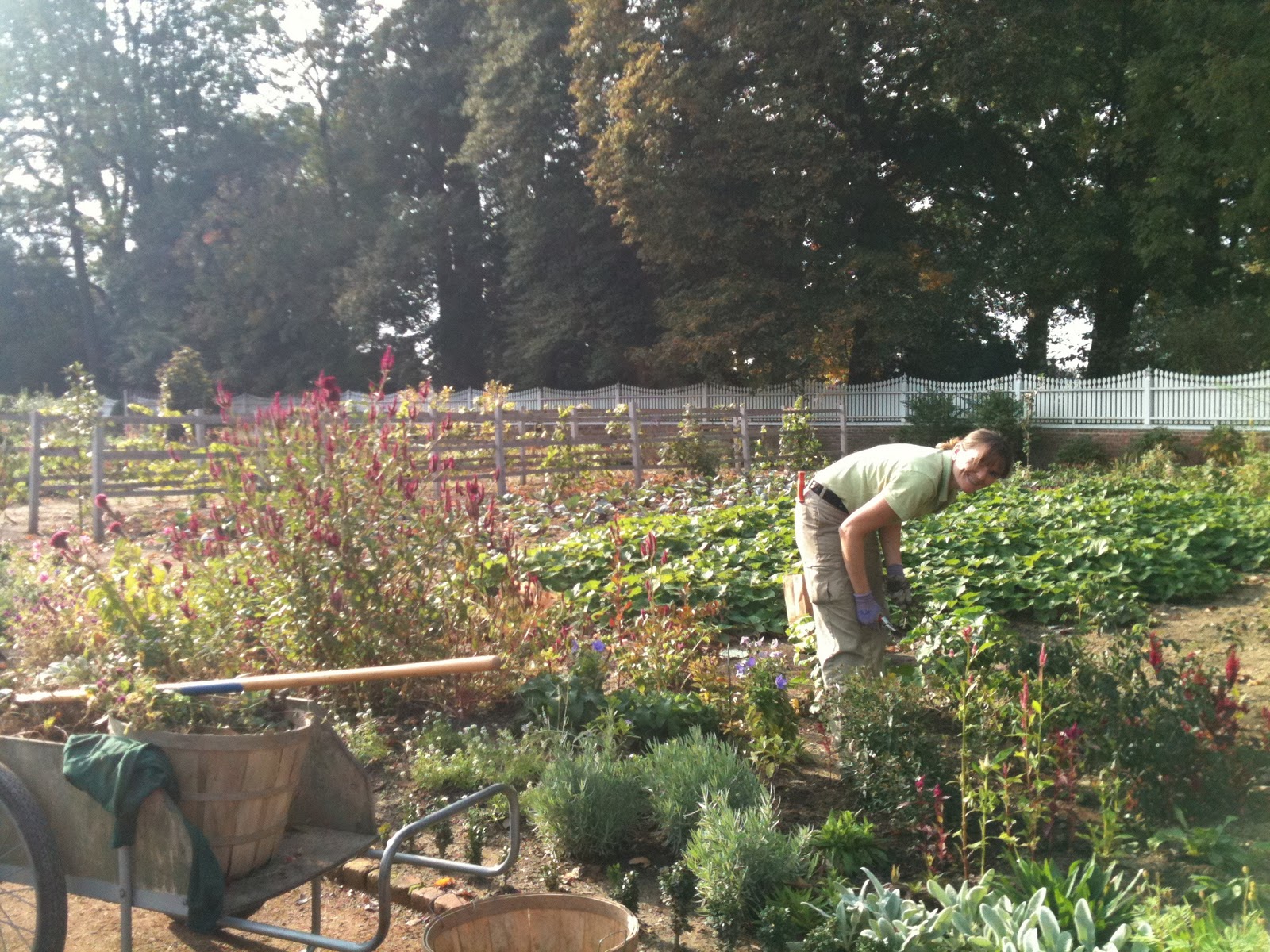
Name of this plant escapes me, but it added a lot of color to the upper garden's post-harvest bareness

 Where did that America go?  How far we've strayed.

 "The love of my country will be the ruling influence of my conduct."
Again... How far we've strayed.  I bristle when a-holes like the guy on my flight tell me I'm not patriotic because I support #OccupyWallStreet / #OccupyTogether. I LOVE MY COUNTRY, & yes, I'd die for it. Parcels of land in Alexandria were sold in a way that ensured the less well off had a chance to own land too.  Where did that America go?  I'm fighting for the fairness, compassion, peace, sustainability & basic human rights that made up the spirit of our original laws. Corruption & greed has perverted & twisted the interpretation of our founding fathers' words, & we need to take our country back.

What would George Washington think of Monsanto?  What would he think about the destruction of America's bread basket via pesticides, herbicides, & genetically modified crops that cause illness & hunger?  What would he do to a company that knowingly poisons Americans & contaminates our crop diversity so that future Americans will starve? What would he think of gm seed contracts & terminator seed technology that enslaves farmers today?  He'd hang them all for treason.
 
 
  George Washington was a sustainable ag pioneer.  Imagine the number of seasons of trial & error it must have taken to get the right combo of ingredients for fertilizing in his micro-climate. Our founding fathers blazed this trail for us already, and we need to get back to this way of thinking.  Unfortunately, big ag buys up nutrients & the disappearance of fish all over the world will make it hard to do so.  It's all connected... The fish in the ocean are important to the farmers on land growing grains, etc...  Earth's very thin, fragile biosphere is on the brink of being wrecked beyond the point where we can reverse the damage.  It's beginning to snowball.  We're almost at the point where a complete stop to all destructive practices won't help.  Our decline has almost taken on a life of its own. If you like to eat, you better OCCUPY.

The Mt. Vernon mansion would be completely rotted away if it weren't for a group of patriotic local ladies who banned together to save it.  The roof was falling in & had to be propped up with the masts of abandoned ships.  The site is privately owned by the women's group today.  


 Purple hyacinth beans!  I have these growing in the front yard in San Jose.  "They" say the immature pods are okay to eat, but the big ones are toxic, so not sure why they grow them here.  Most plants left in the garden & farm were left to produce seed.  I had never seen an okra flower.  It kind of looks like hibiscus or yarrow.  Okra was a lot taller than I thought it would be too.
Adorable, affectionate ram that LOVED being scratched behind the ears.  He'd lean in for good measure.  This is where my iphone camera ceased working.  I had a photo of him leaning into my hand, but won't come up.  Sigh.  Had to buy disposable camera at Arlington.


Gardener action!

Wheat grown for demonstration only.  They let it rot in piles everywhere.  Seems a shame to waste it.  They should at least share it as seed.  Stole a handful.


Tobacco


 I had never seen cotton plants close up.  Had to steal some cotton wool with seeds.  Will see if I can get it to grow in NOLA, along with the peanut, wheat, the black walnut I stole from the Capital, and the acorn I took from Arlington Cemetary.  

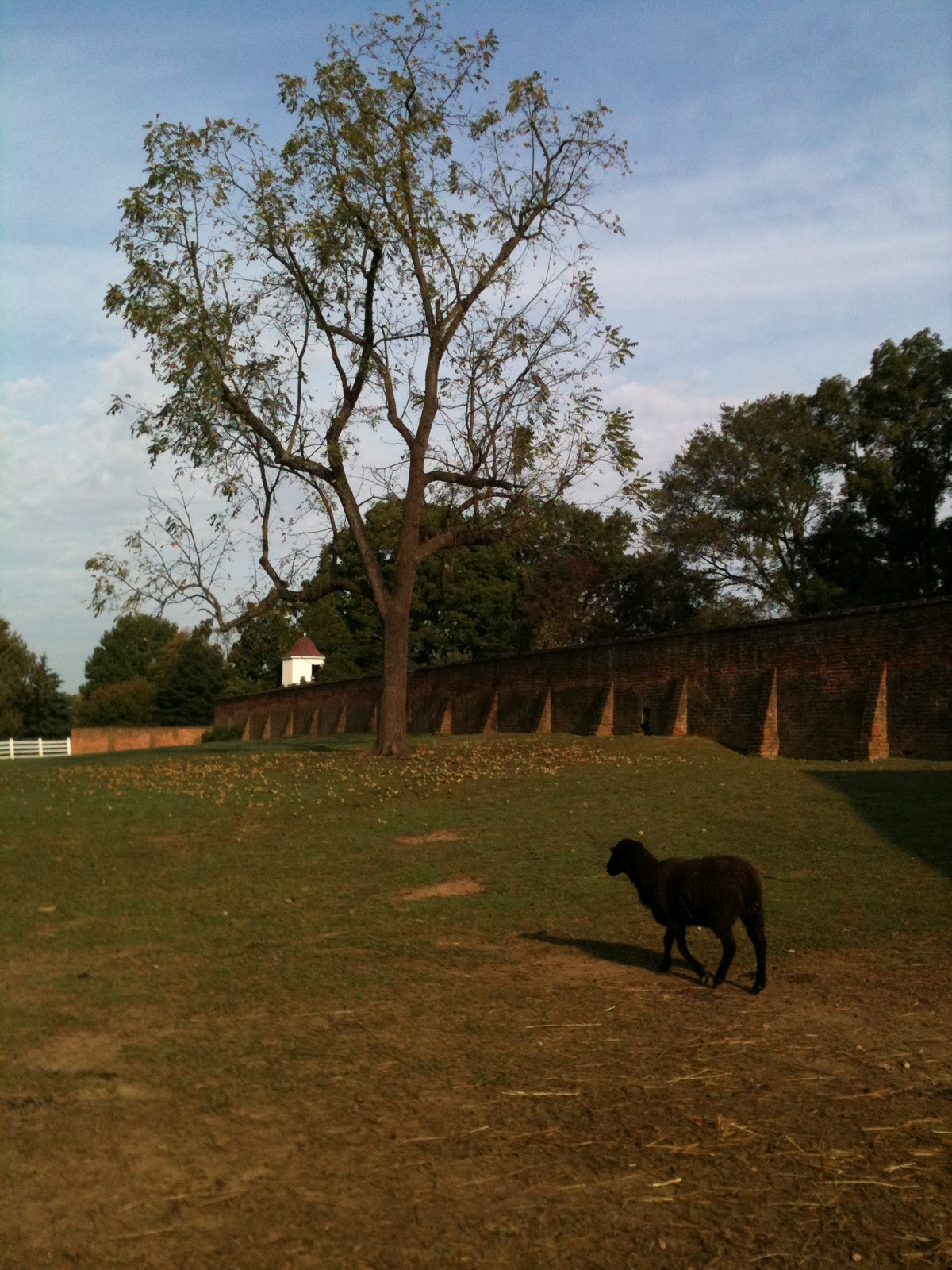
  Black sheep breaks away from the pack of white sheep to blaze his own trail.  My kind of sheep.


 George & Martha Washington's tomb.  We said the pledge & laid a wreath before taking our photos.


 A man dressed as a slave demonstrated plowing with oxen & showed me heritage chickens GW encouraged slaves to raise for themselves.

From here we went to Christ Church in Alexandria, Arlington Cemetery, Lincoln Memorial, Vietnam Memorial, WWII Memorial & (empty) reflecting pool.  Photos of those spots are on disposable camera.  Coming soon.  Have lots to say about that.